


Celebrating Tibor Hajas’s 80th Birth Anniversary
Celebrating Tibor Hajas’s 80th Birth Anniversary
Tibor Hajas (1946 – 1980) és Steve Lacy (1934 – 2004)
Divertimenti
music/performance by the Fidelio Quartet, Sheryl Sutton (long distance) & distinguished guests.
Inspired by Janos Pilinszky’s home rendition of Grotowski’s The Constant Prince, I formed a performance group in 1968 with the poet Tibor Hajas and the sculptor Istvan Dombrowszky. I was not interested in scripted plays. My sights were set on street theater, engaging an “unwitting public,” knowing that the general public is – unwittingly or not – by definition unwitting. Everything we contemplated doing – and the little that we did – was illegal. Our first planned performance was to paint a poem of mine across a wall of the Ganz Electrical Factory over graffiti-like party-slogans.
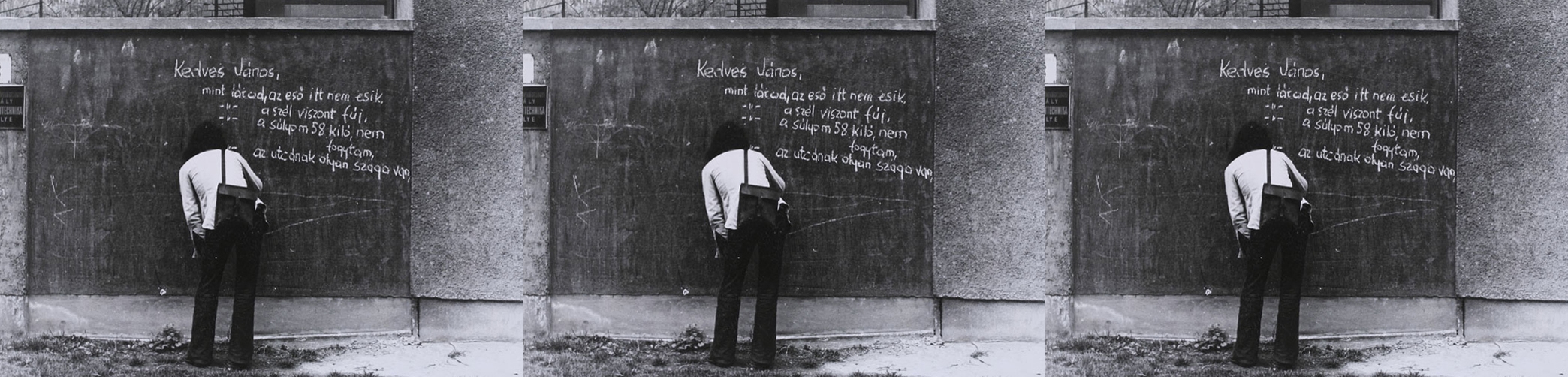
Dombrowszky committed suicide in the spring of 1969 and our group never got to perform. I escaped from Hungary in June, went to Italy for a few months, and then to Israel for a couple of years. In Tel Aviv I planned to graffiti a better (Hebrew) poem on a wall, but lost interest when a factory owner proposed the perfect concrete wall for the project. The messenger is the message: I craved illegality. Instead, I put on performances with electronic noise by the great violist Yossi Gutmann. Our idea of 1968 was brought to fruition by Hajas in 1975 in his first documented performance, Letter to my Friend in Paris. Writing across a Budapest wall, he addressed to me words that were worth all seven years’ of wait.
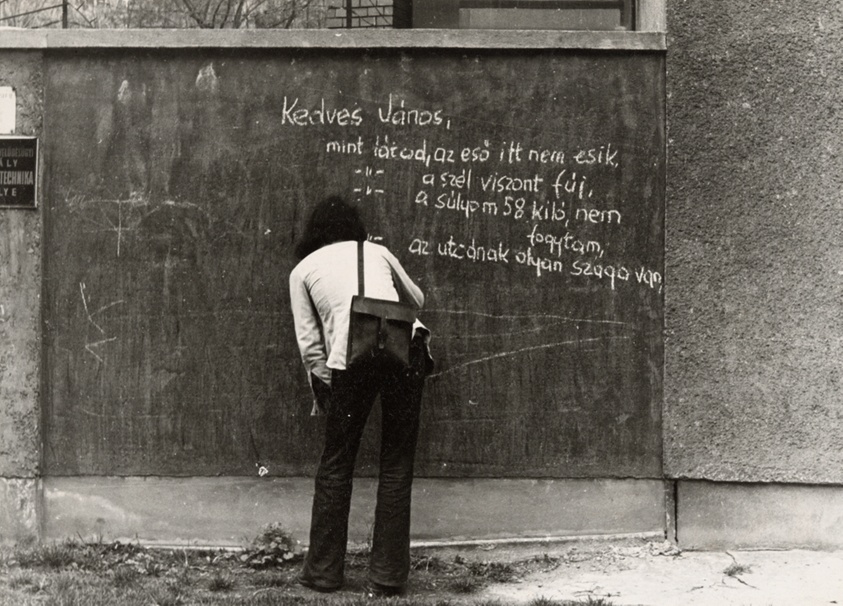
Levél barátomnak Párizsba (1975) fotó: Veres Júlia
My one “indoor” project in Hungary was also meant for outdoors: the Aquincum Roman amphitheater. Modeled on Greek tragedy, Window View was eventually performed in 1975 at the Arènes de Lutèce, the beautiful Roman amphitheater in Paris. Taken with the acoustics of the venue, Steve Lacy planned to play Precipitation Suite as incidental music. His sextet would have been located, like the audience, above the action. Nomen est omen: the event had to be rescheduled due to a rainstorm, and Lacy left for an all-important tour in Japan. Disappointed as I was at the time, the sound effects improvised by the last-minute guitarist Fabien Ferreux echoed the riffs of Iván Fülöp – Dombrowszky’s younger brother – who played guitar during the rehearsals we had back in Budapest.
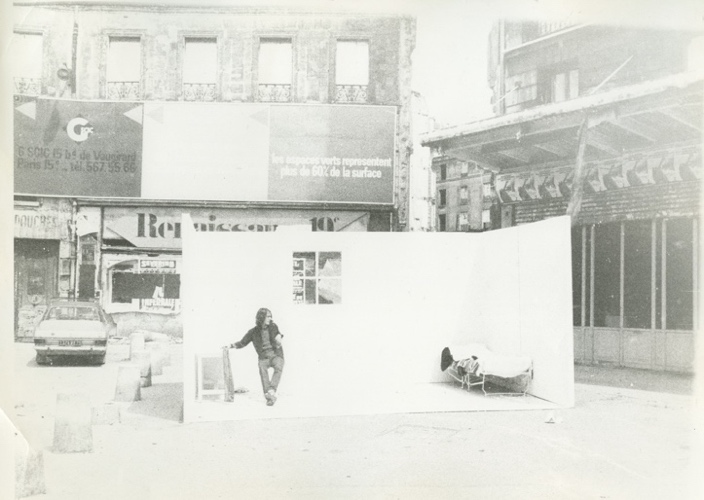
Háromnapos színjáték (1975, Párizs, Belleville)
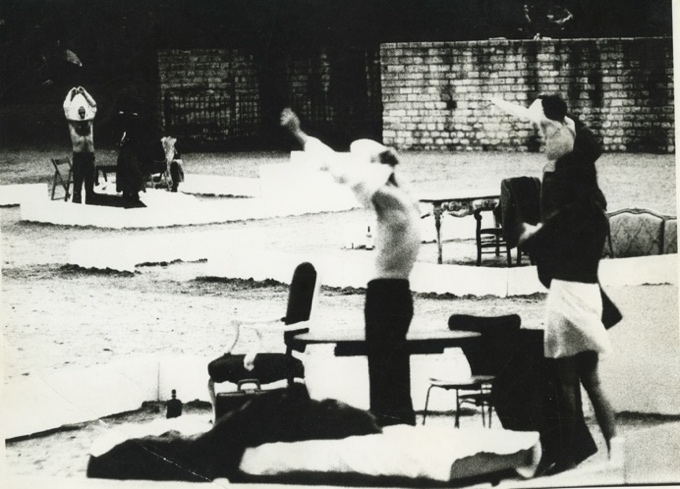
Ablaknézet (1975, Párizs, Arènes de Lutèce)
I lived in Paris between 1971 and 1976. At the end of 1972, I formed a theater group to develop and present my amphitheater play. We applied to the selection committee of the 1973 World Theater Festival, Nancy to be invited officially, but were rejected. Then, because my newformed company had other plans, I went to Nancy alone. I turned my original idea of a two-hour, twenty-actor theater piece about life in general into the Three Day Play: a seventy-two-hour solo performance, in which I would play out seventy-two years of a life – mine and the audience’s. My illegal street theater event – much imitated over the years – became the certified hit of the festival and the 1975 version took place mostly on the streets.
In the first few years I kept corresponding with my closest friend, Tibor Hajas, on an almost weekly basis. Much of our lives and artistic output was influenced by this correspondence and our dialogue did not end with his untimely death, as evidenced by the anthology of his collected texts and this concert-performance celebrating what would have been his eightieth birthday. When, in May 1973, I wrote to Hajas from Nancy about my latest theatrical concept (the silent actor-hero showing Ecce homo-like against a cacophonic audience he manipulates as his readymade chorus), he replied by describing his own concept for a performance, which is historical, as it was the first one he had ever devised.
The instructions for Mozart Unbound (my posthumous title) are as follows:
1. A string group assembles to play Mozart.
2. In the middle of the first movement the musicians with portable instruments get up and start to disperse, possibly in nature.
3. The audience can stay put or follow one or another player.
4. At the end, the musicians may or may not even hear each other, perhaps lost in the woods. For all present at all times all sounds are different.
Hajas sent me this in the spring of 1973 and I became friends with Steve Lacy in the fall of that year. Hearing about Hajas’s Mozart action, Lacy told me he had been exploring similar ideas since 1969.
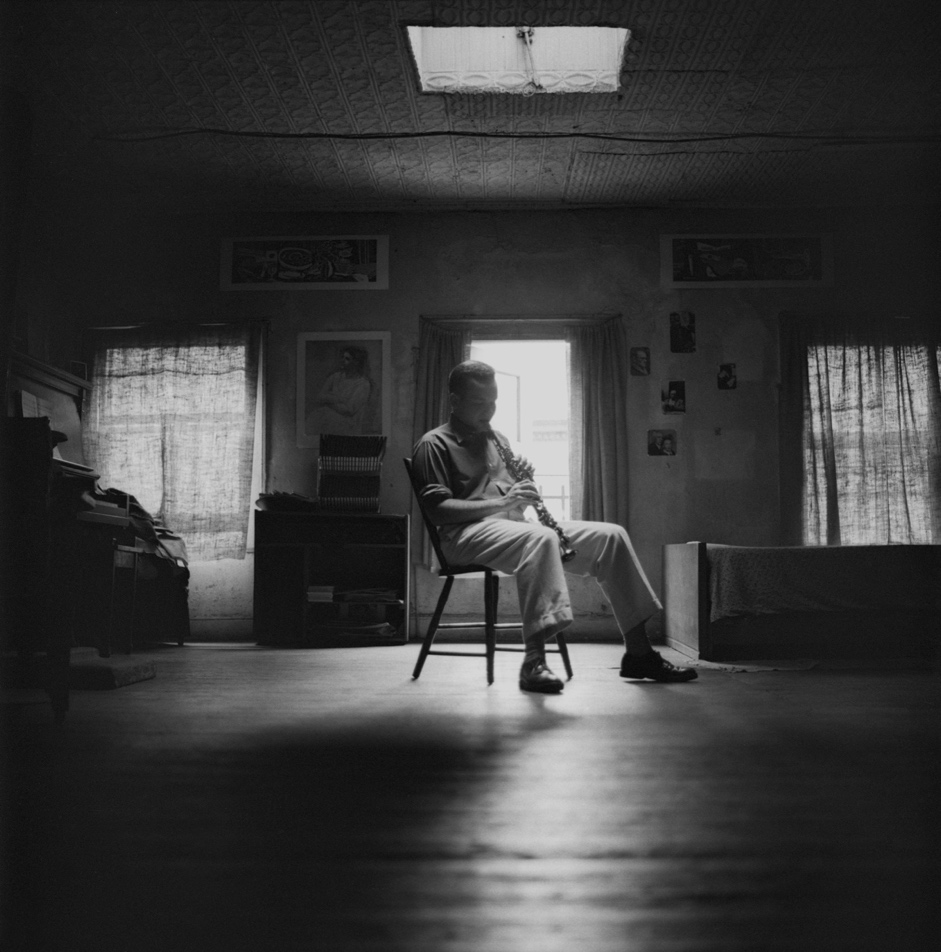
Steve Lacy (1963, fotó: Jerry Schatzberg)
Living in Rome in the late 1960s, American expatriate soprano saxophone player Steve Lacy began writing orchestral pieces, two of which – Precipitation Suite and Garden Variety – exemplify his interest in ambient sounds and the environment. In 1970, Lacy relocated to Paris, where he completed both compositions and – inspired by meeting a new cohort of experimental musicians – put together an ensemble to play his music with Irène Aebi on cello and Kent Carter on bass, along with the trumpeter Ambrose Jackson and the drummer Jerome Cooper. Lacy would advance an idiosyncratic resolution of the ideals of freedom with his musical aesthetic, mixing jazz technique with Cage’s embrace of sound, and incorporating dance and visual elements.
Lacy presented an early, bare-bones Garden Variety in Rome, then staged a large-scale version in Paris on January 4, 1971 at the Théâtre de l’Epée de Bois. His group – soon to be a more or less constant sextet – was joined by Anthony Braxton and Gordon Mumma, and also the dancer Sheela Raj. Lacy said that “According to John Cage, all sounds are harmless, therefore, this piece is dedicated to him…” Lacy stated that “Garden Variety means ‘harmless,’ ‘without danger,’ like the type of snake found in gardens… This is a piece which brings the outdoors indoors. It uses natural sounds on tape, various musicians & a dancer, as well as certain items found outside & used as decor (branches, leaves, etc.). Once the elements & players are assembled in the space & the form determined (the length of tape, etc.), the piece finds its own way freely.”
Lacy indicated that the performance was “meant to be a divertissement [Divertimento],” a characterization that contrasts rather starkly with the previous years’ increasingly political interpretations of free music. Lacy was promoting a playful attitude toward the serious and a serious attitude toward play. Rejecting the exclusionary aspects of free jazz, Lacy maintained that its purpose was to bring people together through a “certain idealism.” The concept of divertissement gave a down-to-earth perspective to the grandiose utopian view of free improvisation as a universal language with the potential to liberate humanity.
Garden Variety was performed by a core group of participants that kept expanding over the years. The version presented at the Bimhuis in Amsterdam in April 1975 featured Willem Breuker on clarinet, Peter Bennink on bagpipes, Steve Potts on alto sax, John English on trombone, Lodewijk De Boer on viola, Derek Bailey on guitar, Irène Aebi on violin and cello, Maarten Altena on bass, Oliver Johnson on drums, and Harry Sheppard dancing. Garden Variety was revived in 1979 for three nights at the Akademie der Künste in Berlin. Joined by Yossi Gutmann and additional free improvisors, the musicians and dancers would move around, forming and reforming temporary units according to precomposed timings. The audience was also brought in on equal footing: the event was described as “a performance without a stage,” in which “the audience is constantly wandering with the action.”
In Garden Variety and Precipitation Suite Lacy demonstrates what free music could accomplish and signify. By calling his compositions divertimenti, Lacy could play his way to freedom. For Lacy, free improvisation meant a collective creative burst for all involved to explore direct communication in a nascent environment – much like the natural world he was engaging with in Garden Variety and emulating in Precipitation Suite.
Janos Gat, 2026. The information on Steve Lacy includes material from the forthcoming book by Evan Rapport, Steve Lacy: The Life and Music of a Jazz Composer (University Press of Mississippi, 2027).